Authentic French Brioche Bread: Silky and Buttery

- Time: Active 30 minutes, Passive 880 minutes, Total 910 minutes
- Flavor/Texture Hook: Silky, buttery, and incredibly fluffy
- Perfect for: Holiday brunches or a decadent weekend baking project
- Mastering This Fluffy French Brioche Bread Recipe
- Essential Specs for Your Baking Schedule
- Selecting Premium Ingredients for Better Brioche Results
- Essential Tools for Kneading and Shaping Your Dough
- Your Step by Step Bread Making Guide
- Solving Your Most Frustrating Baking Hurdles
- Creative Ways to Customize Your Golden Loaf
- Storing and Freezing for Maximum Freshness
- The Best Ways to Serve Your Masterpiece
- Popular Misconceptions About Brioche
- Recipe FAQs
- 📝 Recipe Card
Mastering This Fluffy French Brioche Bread Recipe
There is a specific sound that happens when you pull a fresh loaf out of the oven and tap the bottom. It is a hollow, rhythmic thud that tells you the air has done its magic. The first time I tried a french brioche bread recipe, I was mesmerized by the way the butter transformed a shaggy, sticky mess into something that looked like spun silk.
I remember standing in my kitchen at midnight, watching the stand mixer work, wondering if adding that much butter was actually legal. It felt more like making a pastry than a bread, and honestly, that is exactly what brioche is.
The magic of this specific method lies in the patience we give the yeast. When you bake this, your entire home will fill with the aroma of toasted sugar and rich cream. It is the kind of scent that brings people into the kitchen without you having to say a word.
I have made the mistake of trying to rush the rise before, and I promise you, the wait is where the elegance happens. We are going to walk through this together so your first loaf is just as velvety as mine was.
This is not a quick weeknight bake, but it is a deeply rewarding one. We are using a significant amount of eggs and butter to create an enriched dough that feels like a luxury. You will see the dough transform from a dull clump into a glossy, elastic ball that practically glows.
It is a transformation that feels like a little bit of kitchen alchemy every single time.
Essential Specs for Your Baking Schedule
Understanding the timeline of an authentic french brioche bread recipe is the secret to a stress free morning. Because this dough requires a long, cold rest in the fridge, you actually do most of the work the night before. This cold ferment is not just for flavor, it also makes the high fat dough much easier to shape.
When the butter is cold, the dough is like pliable clay; when it is warm, it can be a bit of a slippery struggle.
The internal temperature of your bread is the most reliable way to tell it is done. We are looking for exactly 190°F (about 88°C). If you pull it out too early, the center will be gummy and collapse as it cools.
If you wait too long, that beautiful moisture we worked so hard for will evaporate, leaving you with a dry crumb. Stick to the numbers, and you will have a masterpiece every time.
| Method | Total Time | Texture | Best For |
|---|---|---|---|
| Traditional Cold Ferment | 15 hours 10 mins | Silky, tight crumb, deep flavor | Sandwiches, French toast, gifting |
| Room Temp Shortcut | 4 hours | Airy, slightly yeasty, less rich | Same day dinner rolls |
| Overnight Counter Rise | 10 hours | Open crumb, can be over proofed | Not recommended for high butter dough |
Building that structure takes time because the fat from the butter and eggs actually slows down the yeast. Think of the yeast as a tiny engine trying to move a very heavy, delicious load. It needs those extra hours in the fridge to slowly build up gas bubbles without the dough becoming too soft to handle.
Selecting Premium Ingredients for Better Brioche Results
The quality of your ingredients is everything when the list is this short. For a french brioche bread recipe, I always reach for the best unsalted grass fed butter I can find. Since nearly a third of the dough is butter, the flavor of the fat will be the star of the show.
Using a butter with a higher fat content and lower water content ensures that the bread stays tender and doesn't get tough or bread y.
We also use bread flour here instead of all purpose. This is a non negotiable for me. The higher protein content in bread flour creates a stronger gluten network that can support all that heavy butter and honey.
If you use a lower protein flour, the loaf might struggle to rise or could even collapse under its own weight during the final proof.
| Ingredient | Science Role | Pro Secret |
|---|---|---|
| Bread Flour (500g) | Provides the structural framework | Always weigh it for accuracy |
| Grass Fed Butter (225g) | Interferes with gluten for tenderness | Must be "pliable" but not melted |
| Large Eggs (5 units) | Adds fat, color, and leavening power | Use room temperature eggs only |
| Honey (40g) | Retains moisture and feeds yeast | Adds a floral note better than white sugar |
It's also worth noting the role of salt in this dough. We use 10g of fine sea salt, which sounds like a lot, but it is essential for balancing the richness of the eggs and honey. Without enough salt, the brioche will taste flat and oily rather than flavorful and complex.
Components and Substitutions
- 60ml warm whole milk (105°F): Provides the initial hydration and fat for the yeast to wake up. Why this? The fat in whole milk creates a softer, more tender crumb than water.
- Substitute: Oat milk (Full fat version works best for richness).
- 7g active dry yeast: Our primary leavening agent that creates the lift. Why this? Active dry allows for a controlled, steady rise during the long ferment.
- Substitute: 5g Instant yeast (Skip the 10 minute bloom and mix directly).
- 500g bread flour: The backbone of the entire structure. Why this? High protein is needed to hold up the heavy fat content.
- Substitute: All purpose flour (Result will be significantly less fluffy and more dense).
- 225g unsalted grass fed butter: This provides the iconic velvety texture. Why this? Grass fed butter has a deeper yellow hue and richer flavor profile.
- Substitute: high-quality European style butter (Look for 82% fat content).
- 40g honey: Adds sweetness and helps with browning. Why this? Honey is a humectant, meaning it keeps the bread moist for longer.
- Substitute: Maple syrup (Adds a slight caramel undertone).
Essential Tools for Kneading and Shaping Your Dough
To truly master this french brioche bread recipe, a stand mixer is your best friend. While you can knead this by hand, the process of incorporating 225g of butter into 500g of flour is a workout that takes about 25 to 30 minutes of vigorous slapping and folding.
A stand mixer with a sturdy dough hook allows for consistent gluten development without the heat from your hands melting the butter prematurely.
You will also need a standard 9x5 inch loaf pan. I prefer metal over glass or ceramic because it conducts heat more evenly, giving you that beautiful golden brown crust on all sides. A digital kitchen scale is also vital.
In baking, especially with enriched doughs, measuring by volume (cups) is too imprecise and can lead to a dry loaf if you pack too much flour in.
The Fat Emulsion Principle
The secret to the velvety texture of brioche is how we add the butter. If you add it all at once, the fat coats the flour particles and prevents the gluten from forming, resulting in a greasy, crumbly cake.
By adding the butter one tablespoon at a time after the initial gluten has formed, we create an emulsion. The fat is suspended within the gluten network, allowing the bread to rise high while remaining incredibly tender. It is a slow process, but it is why the bread feels like a cloud when you bite into it.
Your step-by-step Bread Making Guide
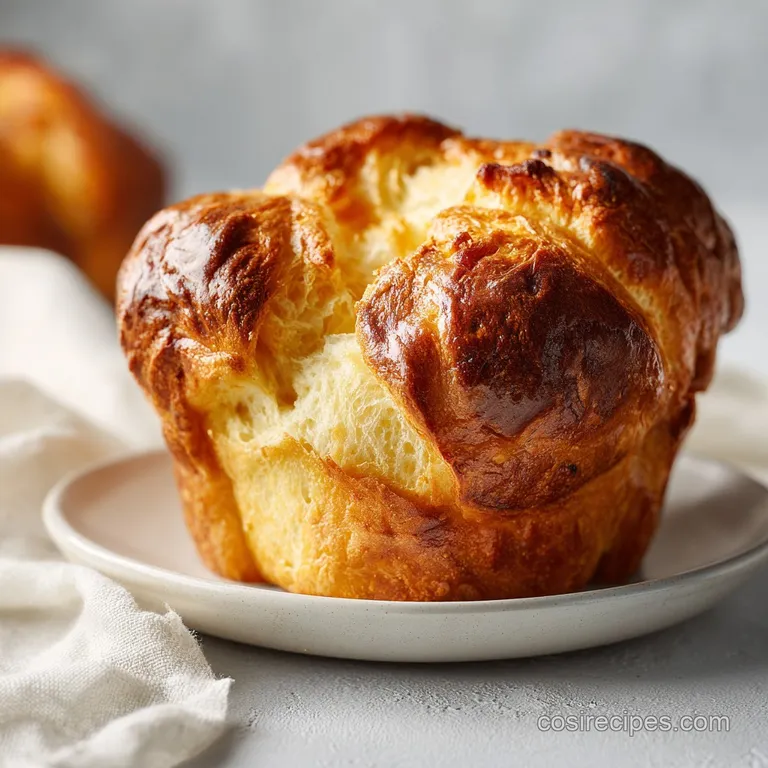
Bloom the yeast. Combine 60ml warm whole milk (105°F), 7g active dry yeast, and a 10g granulated sugar in your stand mixer bowl. Whisk gently and let it sit for 10 minutes until a thick, foamy head forms on top.
Note: This confirms your yeast is alive and ready to work.
Combine initial ingredients. Add 500g bread flour, 40g honey, 10g fine sea salt, and 5 room temperature eggs to the bowl. Note: Room temp eggs prevent the butter from seizing later.
Develop the gluten. Using the dough hook, mix on low for 5 minutes to hydrate the flour, then increase to medium for 5-8 minutes until the dough gathers into a smooth ball and pulls away from the sides.
Incorporate the butter. Set the mixer to medium low. Add 225g softened butter one tablespoon at a time. Wait until each piece is completely absorbed before adding the next. This should take about 10-12 minutes.
Perform the windowpane test. Once all butter is in, continue mixing for 3-5 minutes until the dough is glossy, elastic, and can be stretched thin enough to see light through it without tearing.
Start the cold ferment. Place the dough in a greased bowl and cover tightly. Refrigerate for 14 hours 40 mins. Note: The dough will firm up and develop a complex, buttery flavor during this long rest.
Shape the loaf. Gently punch down the chilled dough and shape it into a tight log. Place it into a greased 9x5 inch loaf pan.
The final proof. Let the loaf rise at room temperature for about 2 to 3 hours until it has doubled in size and feels like a soft marshmallow when gently poked.
Apply the finish. Whisk 1 egg with 1 tbsp heavy cream. Brush the top of the loaf gently until every crevice is coated in a thin, even layer.
Bake to perfection. Preheat your oven to 350°F (175°C). Bake for 30 minutes until the top is a deep mahogany brown and the internal temperature hits 190°F.
Solving Your Most Frustrating Baking Hurdles
Sometimes things don't go exactly as planned, and that is okay! The most common issue with a french brioche bread recipe is the dough feeling too soft or "soupy" during the butter incorporation phase. If your kitchen is very warm, the butter can start to melt rather than emulsify. If this happens, don't panic.
Just pop the whole mixer bowl in the fridge for 15 minutes to cool everything down, then continue mixing.
Another frequent worry is the dough not rising enough during the cold ferment. Remember, the fridge is meant to slow things down! You might only see a 20% increase in volume while it is in the cold, and that is perfectly normal.
The real "oomph" happens during the final proof at room temperature and the initial "oven spring" when the heat hits the yeast.
The Dough is Falling Apart
If your dough looks shredded or greasy after adding the butter, you may have added it too fast or the dough wasn't kneaded enough beforehand. High fat doughs are delicate. To fix this, stop adding butter and keep the mixer running on medium for a few minutes.
Usually, the gluten will eventually catch up and pull the fat back into the fold.
| Problem | Root Cause | Solution |
|---|---|---|
| Dough is greasy and oily | Butter was too soft or added too quickly | Chill dough for 20 mins, then resume mixing |
| Crust is dark but middle is raw | Oven is too hot or rack is too high | Tent with foil and move to a lower rack |
| Bread is dry and crumbly | Too much flour or overbaked | Use a scale next time; check temp at 25 mins |
One of the best things you can do for your baking is to treat every "fail" as a lesson. If you love the buttery flavor of this loaf but want something with a bit more texture for breakfast, you might enjoy my Apple Streusel Bread. It uses similar principles but adds a wonderful crunch on top.
Common Mistakes Checklist
- ✓ Never use cold butter; it won't emulsify and will leave chunks in the dough.
- ✓ Don't skip the windowpane test; without gluten, the bread will be a brick.
- ✓ Avoid adding extra flour when shaping; use a light touch and trust the chill.
- ✓ Always use a thermometer to check doneness; color can be deceiving.
- ✓ Let the bread cool for at least 1 hour before slicing to set the crumb.
Creative Ways to Customize Your Golden Loaf
Once you have mastered the classic french brioche bread recipe, you can start playing with the flavors. For a savory version, I love folding in 50g of grated Gruyère and a tablespoon of chopped fresh rosemary during the last minute of mixing.
The cheese melts into the dough, creating little pockets of salty goodness that are incredible for ham sandwiches.
If you are scaling this recipe down for a smaller household, you can easily halve the ingredients. However, because eggs are hard to split, I recommend whisking one egg and using exactly half by weight.
If you are scaling up to make two loaves, simply double everything, but be aware that your stand mixer might struggle with a double batch of this heavy dough. Work in batches if your mixer is smaller than 5 quarts.
| Servings | Ingredient Adjustments | Pan Size | Cook Time |
|---|---|---|---|
| 6 People | Half all ingredients (use 2.5 eggs) | 8x4 inch pan | 25 minutes |
| 12 People | Standard recipe (as written) | 9x5 inch pan | 30 minutes |
| 24 People | Double all ingredients | Two 9x5 pans | 35 minutes (rotate pans) |
For those looking for a truly elegant presentation, try braiding the dough. Instead of a single log, divide the dough into three equal pieces, roll them into long ropes, and braid them together.
It increases the surface area for that beautiful egg wash to shine, making the loaf look like it came straight from a Parisian bakery.
Storing and Freezing for Maximum Freshness
Because of the high fat and honey content, this brioche actually stays fresh longer than standard white bread. You can keep it in an airtight bag at room temperature for about 3 to 4 days. Whatever you do, don't put it in the fridge once it's baked!
The cold temperature of a refrigerator actually accelerates the staling process of the starch, making the bread feel dry and tough.
If you can't finish the loaf in a few days, the freezer is your best friend. I suggest slicing the bread before freezing. This way, you can pull out a single slice and pop it directly into the toaster. It will stay fresh in the freezer for up to 3 months.
To reheat a whole loaf, wrap it in foil and bake at 300°F (150°C) for 10-15 minutes until it feels soft again.
Zero waste tip: If you do end up with a few stale slices, do not throw them away! Stale brioche is the gold standard for bread pudding or French toast. If you have leftovers, you should definitely try using them for my Brioche French Toast Casserole. The dry bread soaks up the custard perfectly without becoming mushy.
The Best Ways to Serve Your Masterpiece
While this bread is a star all on its own, it plays very well with others. A thick slice, toasted and spread with salted butter and a bit of apricot jam, is my idea of a perfect breakfast. The sweetness of the honey in the dough complements tangy fruit preserves beautifully.
If you want to go the savory route, this brioche makes the absolute best base for a grilled cheese sandwich. Use a sharp white cheddar and maybe a thin slice of green apple inside. The buttery crust of the bread fries up to a perfect golden shatter that contrasts with the melted cheese.
It's an elegant upgrade to a childhood classic.
Another fun idea is to use this dough to make individual brioche buns for burgers. Simply divide the dough into 100g portions, roll them into tight balls, and follow the same proofing and baking instructions (though you’ll want to reduce the bake time to about 15-18 minutes). For more inspiration on how to use rich, bready textures in your meals, you might like my Buffalo Chicken Pizza, which balances spice with a soft, doughy base.
Popular Misconceptions About Brioche
One myth that needs to disappear is that you must use milk for a "real" brioche. While milk adds tenderness, some of the most famous bakeries in France actually use water to allow the flavor of the butter and eggs to be more prominent.
In our recipe, we use a small amount of milk to help the yeast bloom, but the primary liquid comes from those five beautiful eggs.
Another common belief is that the dough should be "easy to handle." If your brioche dough feels like standard pizza dough, you haven't added enough butter! At room temperature, this dough should feel almost like a thick, sticky cake batter.
This is why the cold ferment is so critical it's the only way to make the dough behave long enough to get it into the pan.
Finally,, some people think that more yeast equals a better rise. In fact, using too much yeast in an enriched dough can lead to a "yeasty" or sour taste and a crumb that collapses quickly.
The 7g we use is precisely calculated to work slowly and steadily, giving you that fine, tight crumb that defines a high-quality loaf. Trust the process, trust the rest times, and you'll be the master of your kitchen in no time.

Recipe FAQs
What is the secret to a perfect brioche?
Patience during the 14-hour cold ferment. This long rest develops flavor and improves the texture of the dough, while ensuring you only add the 225g of softened butter one tablespoon at a time keeps the emulsion stable.
What makes brioche different from bread?
It is an enriched dough containing high ratios of butter and eggs. Unlike standard loaves, this recipe uses 5 large eggs and 225g of butter to create a tender, cake like crumb, a technique of balancing fats that you can also explore in our Cream Cheese Corn Casserole.
What flour is best for brioche?
Use bread flour exclusively. Its higher protein content is essential to develop the strong gluten structure needed to support the high volume of butter without the loaf collapsing.
Is brioche bread good for diabetics?
No, it is not recommended for diabetics. This bread is high in refined carbohydrates from the bread flour and contains honey, which can cause significant blood sugar spikes.
How to ensure the butter incorporates properly?
Add the softened butter one tablespoon at a time while the mixer runs on medium low. Wait for each piece to vanish into the dough completely before adding the next to ensure the butter emulsifies rather than creating greasy streaks.
How to tell when the brioche is finished baking?
Insert a digital thermometer into the center of the loaf. The bread is ready to be removed from the 350°F oven once it reaches an internal temperature of exactly 190°F, as color alone does not guarantee the center is set.
How to store leftover brioche?
Keep the loaf in an airtight bag at room temperature for up to 4 days. Avoid the refrigerator entirely, as the cold environment accelerates staling and will make your bread feel dry and tough.
Authentic French Brioche Loaf
Ingredients:
Instructions:
Nutrition Facts:
| Calories | 339 kcal |
|---|---|
| Protein | 8.5 g |
| Fat | 18.2 g |
| Carbs | 35.9 g |
| Fiber | 1.1 g |
| Sugar | 3.6 g |
| Sodium | 325 mg |
